


The Off-Duty Edit
There is a particular hour on a slow morning when the day has not yet decided what it wants to be. The coffee is going cold by choice. The light has moved across the floor and you have not moved with any urgency to meet it. Nothing is asked of you, and so the question of what to wear becomes, briefly, an honest one. Not what will impress, not what the meeting demands, but simply what you would like to be wearing when the hours are entirely yours.
It is tempting to treat these days as a holiday from effort. We reach for the most defeated thing in the drawer and call it comfort. But comfort and surrender are not the same. Off-duty is a standard, not the absence of one. It is the discipline of looking like yourself on a day when no one is watching closely, which is, if anything, the harder test.
The Honesty of Linen
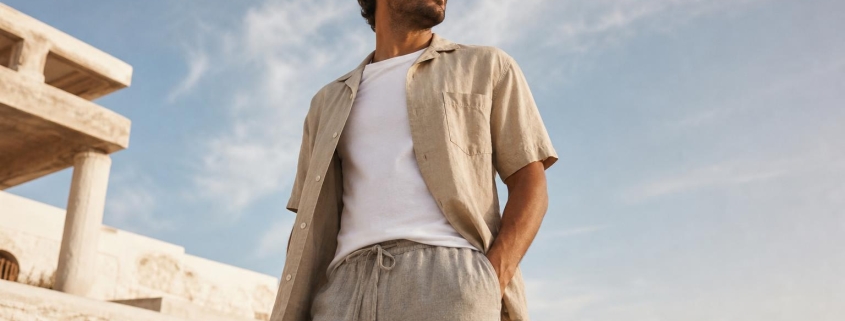
Linen has no interest in flattering you falsely. It creases the moment you sit, it softens with every wash, and it refuses to hold a line it does not believe in. This is precisely why it belongs to the unhurried day. A camp shirt in natural linen, open at the collar, breathes in a way that synthetic ease never manages. It moves air. It moves with you. Paired with linen shorts on a warm stone terrace, it asks nothing and gives everything — the rare garment that improves as the day goes on, gathering the soft architecture of having been worn.
The wrinkles are not a flaw to be ironed out of existence. They are the record of an afternoon spent well.
Soft Tailoring, No Pinch
The off-duty wardrobe still wants structure, only structure that has loosened its grip. A jacket cut without a stiff lining. Trousers that sit easy at the waist and never remind you of their presence. Knitwear that holds its shape across a long lunch and a longer conversation, then forgives you when you push the sleeves up. This is tailoring that has learned to relax without losing its mind — the difference between a garment that fits and a garment that fusses.
The best off-duty pieces are the ones you forget you are wearing, until someone remarks that you look well, and you realise you have done nothing at all.
Fewer Things, Worn Often
There is a version of this edit that lives entirely in a small drawer: a few pieces in sand and ecru and clay, chosen because they sit beside one another without argument. The coastal capsule is not a uniform but a vocabulary — enough to say what you mean on a quiet day, and no more. You do not dress up for it. You do not dress down. You simply dress, with the same care you would give any other day, because the days that ask nothing of you are not lesser days. They are often the ones you remember.
And so the standard holds, gently. The shirt softens, the light shifts, and you are exactly where you meant to be — which is nowhere in particular, dressed for it perfectly.
In Praise of Sand, Ecru and Bone
By eleven o’clock the terrace has gone the colour of weak tea, and everything pale on it seems to lean toward the sun. A bone-coloured sleeve. The chalk of a wall. The light does not so much fall on these things as settle into them, the way warmth settles into stone. You notice, after a while, that the palest things in a room are rarely the quietest. They are simply the most patient.
The Colour of Almost Nothing
Sand, ecru, bone. Said aloud they sound less like colours than like things found on a long walk — and perhaps that is the point. These are the neutrals that refuse to announce themselves. Ecru is what white becomes when it relaxes; bone is the warmth left in a shell after the sea has gone; sand is every shade of afternoon at once. None of them competes with a face, a horizon, or a good meal. They are the considered choice of someone who has decided that the clothes need not do the talking.
There is a discipline in this that masquerades as ease. To wear almost nothing — colour-wise — is to trust the cut, the cloth, the way a linen trouser breaks at the ankle. The Sand Edit sensibility is built on exactly that trust: fewer decisions in the morning, more attention to how a thing is actually made.
How Pale Things Age
The great secret of these tones is that they improve with time. A bone camp shirt softens at the collar and looks better for it. Ecru linen, washed and worn and dried in real air, arrives somewhere gentler than where it began — the creases reading less as wrinkles than as a record of being lived in. Stronger colours fade and feel diminished; the palest ones simply mellow, the way a wall or a worn step does. They were never trying to be new, so they cannot be made to look old.
The palest things keep no secrets and tell no lies; they only hold the light a little longer than everything else.
Quietly, With Everything
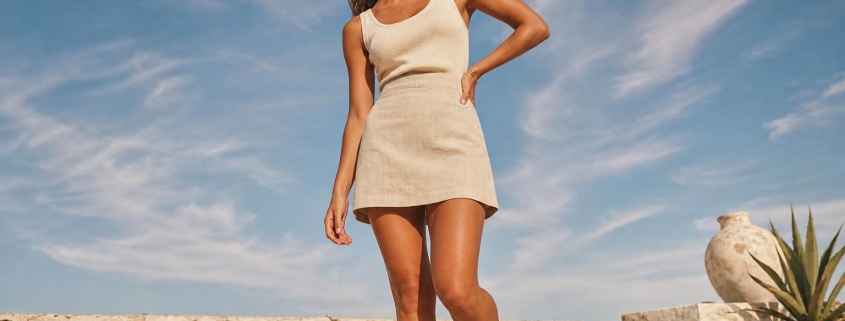
Then there is the matter of getting dressed. A drawer of sand and ecru and bone is a drawer that has already agreed with itself. Nothing clashes when nothing insists. A ribbed tank under a linen skirt, a knit thrown over the shoulders for the cooler end of the evening — the pieces fall into conversation without being asked. This is the off-duty logic of a coastal capsule: a small, warm-toned company of things that travel together, layer together, and ask very little of you in return.
Choose the palest neutrals and you are, in a sense, choosing the background — letting the day and the people in it carry the colour. There is a generosity in that. As the light goes long and gold over the terrace and someone calls everyone in to dinner, the bone and the sand and the ecru simply hold the last of it, and let the evening do the rest.
The Case for Fewer, Better Tees
There is a particular morning shape to a good tee. It is the thing you reach for before the coffee has fully done its work, before you have decided what kind of day it will be. You pull it on without thinking, and that is rather the point — the best ones never ask to be considered. They simply sit right, soften with washing, and go on quietly being there.
The Drawer Tells the Truth
Most of us own too many tees and wear three of them. The rest live folded, untouched, the cotton already gone thin and papery after a season, the neckline slack and curling. They were never meant to last; they were meant to be replaced. And so we keep replacing them, and the drawer fills with near-misses.
The alternative is less romantic than it sounds and more satisfying than it has any right to be. A handful of tees, chosen properly, worn often, washed gently, kept for years. Fewer decisions in the morning. More room in the drawer. A sense, faint but real, of having stopped feeding something that was never giving anything back.
What to Look For
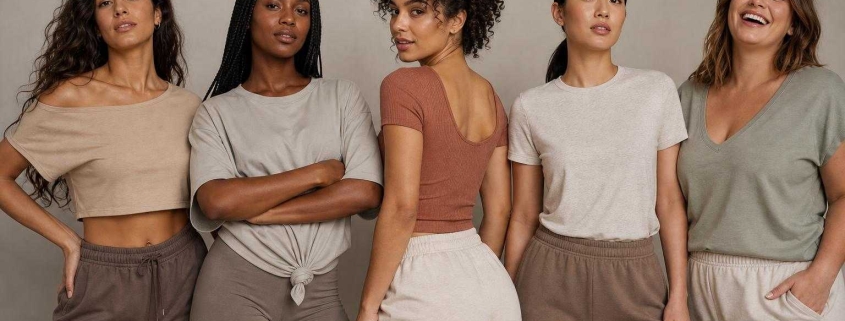
Start with weight. A tee that feels almost weightless on the hanger will feel like nothing on you in the worst way — translucent, clingy, finished by autumn. A medium-weight cotton, something with a little body to it, drapes instead of clings and holds its shape through a long day. You can feel the difference the moment you lift it.
Then the neckline, which is where cheap tees fail first. Look for a collar that is ribbed and snug, stitched to return to itself after it stretches. A good crew sits flat against the collarbone; a good neckline, a year on, still does. This is the detail that separates a tee you keep from a tee you quietly retire.
And consider how it will age, because it will. Honest cotton softens rather than dissolves. It takes on the faint character of the body that wears it and the wash it goes through, fading by degrees into something better than new. That slow settling-in is not wear and tear. It is the garment becoming yours.
A good tee is the most-worn thing you own and the least-noticed. That is exactly its job.
The Foundation Under Everything
This is the layer beneath the linen trousers and the camp shirt, the thing the coastal capsule quietly rests on. Off duty, it is the whole outfit. On the days that ask a little more, it is the calm beginning everything else is built over. Either way it does its work without comment, which is the highest thing a plain garment can do.
Buy fewer of them, then. Buy the ones that feel like something in the hand. Wear them until they have learned your shape, and they will keep on being the easiest decision of the morning — long after you have forgotten you made it.

The honest cost of unintentional design
The pitch sounds reasonable. A founder needs a brand. A designer on Upwork can produce something serviceable for under five thousand dollars. The logo lands within a week. The team moves on. The “branding problem” is solved.
It almost never is.
What you actually paid for
Cheap brand work isn’t bad work. It’s bounded work. The deliverable is a logo file. Maybe a pair of brand colors and a typeface. What it cannot deliver — what no fixed-price three-day engagement can deliver — is a position. A point of view. A reason your brand should exist alongside the seventeen other companies competing for the same buyer.
That gap shows up in everything downstream. Every landing page now requires a writer to invent a voice. Every investor deck has a tonal personality of its own. Every piece of content reads like it came from a different company, because it did. Each downstream asset bears the cost of the missing decision.
The compounding bill
The first time we sat with a client to redo a brand they’d shipped twelve months earlier, we asked what the original engagement had cost. Three thousand. The redo? Forty-six thousand, plus eight months of marketing output that had to be entirely retrofitted to the new identity, plus a Series A that the partners later told them they almost didn’t lead because the brand “felt off.”
The cheap brand wasn’t three thousand dollars. It was three thousand plus forty-six thousand plus eight months plus a Series A scare. Cheap wasn’t cheap.
What “expensive” buys
What you’re buying when you pay for thoughtful brand work is not a logo. It’s the discovery that goes into the logo. The interrogation of what the company is for. The synthesis of competitor positioning. The rigorous decision about what tone of voice you can live with for the next decade. The logo is the artifact of that thinking. Without the thinking, the artifact is a placeholder you’ll replace.
If you can afford to replace it, replace it. If you can’t — if the position you’re building requires brand consistency over the next ten quarters — pay for the work that makes consistency possible.

What we learned shipping eight brands in twelve months
Last year, our four-person studio shipped eight full brand and web identities for Series A startups. None of the projects ran late. None went over scope by more than fifteen percent. We thought we’d collapse halfway through. We didn’t. Here’s what made it possible — and what we’d change.
The non-negotiable: scope locks at week two
Every project has a discovery phase. Ours was three working sessions in week one, followed by a written scope document signed by the founder in week two. After that, anything new is a change request that adds time and cost. No exceptions, no goodwill creep.
We held the line on this for six of the eight projects. The two we softened on — both founders we adored — ran the longest and burned us out the most. The lesson held: scope discipline is kindness, not coldness.
The unexpected bottleneck: feedback loops
We expected design execution to be the constraint. It wasn’t. The constraint was feedback turnaround. A two-day delay in client review compounded across six rounds of work on each project, becoming weeks. We started scheduling weekly thirty-minute review calls instead of waiting for async comments. Cycle time dropped 40%.
The thing that broke: archive discipline
By month nine we couldn’t find anything. Project files lived across Figma, Notion, Dropbox, Slack threads, and individual desktops. We spent half a day every week looking for assets we’d shipped six weeks earlier. We rebuilt our internal asset architecture in December. The next year of project starts cost half as much in onboarding overhead.
What we’d do differently
Hire one more person. We treated four as a feature; it was actually a bottleneck. The fifth role — a junior brand designer who could own the long-tail asset production — would have given us another four projects in the same year without the burnout.

Stop hiring agencies. Hire studios.
The first mistake most founders make when they need brand work is calling an agency. The second is calling a freelancer. There’s a third option that almost nobody considers, and it’s usually the right one for companies under thirty employees: a studio.
What an agency actually is
A fifty-person agency has fifty people’s salaries to cover. The math forces certain behaviors: minimum engagement sizes well into six figures, a senior creative team that pitches the work and a junior team that produces it, account managers translating between client and maker, multi-month timelines built around team utilization, not the project. None of this is a flaw of the agency model. It’s the model.
What a studio actually is
A six-person studio has six people’s salaries. The senior creative who sold the work also makes the work. There is no account manager. The conversation about what the brand should be is the same conversation that produces the file you receive. The deliverable arrives faster because there are fewer hand-offs to get wrong.
This is not a moral judgment. Both models are appropriate, just for different problems. A multinational shipping forty regional campaigns wants the agency. A founder building one brand wants the studio.
The economic difference for early-stage
An agency engagement that produces a brand for $250,000 with a four-month timeline. A studio engagement that produces the same brand for $40,000 with an eight-week timeline. The studio brand is not 16% as good as the agency brand because of the price ratio. They are roughly equivalent in quality and the studio version usually has more directness because fewer people compromised it.
If you’re Series A or B and you need a brand: hire a studio. If you’re Salesforce and you need to launch in eighteen markets at once: hire an agency. Match the structure to the problem.